
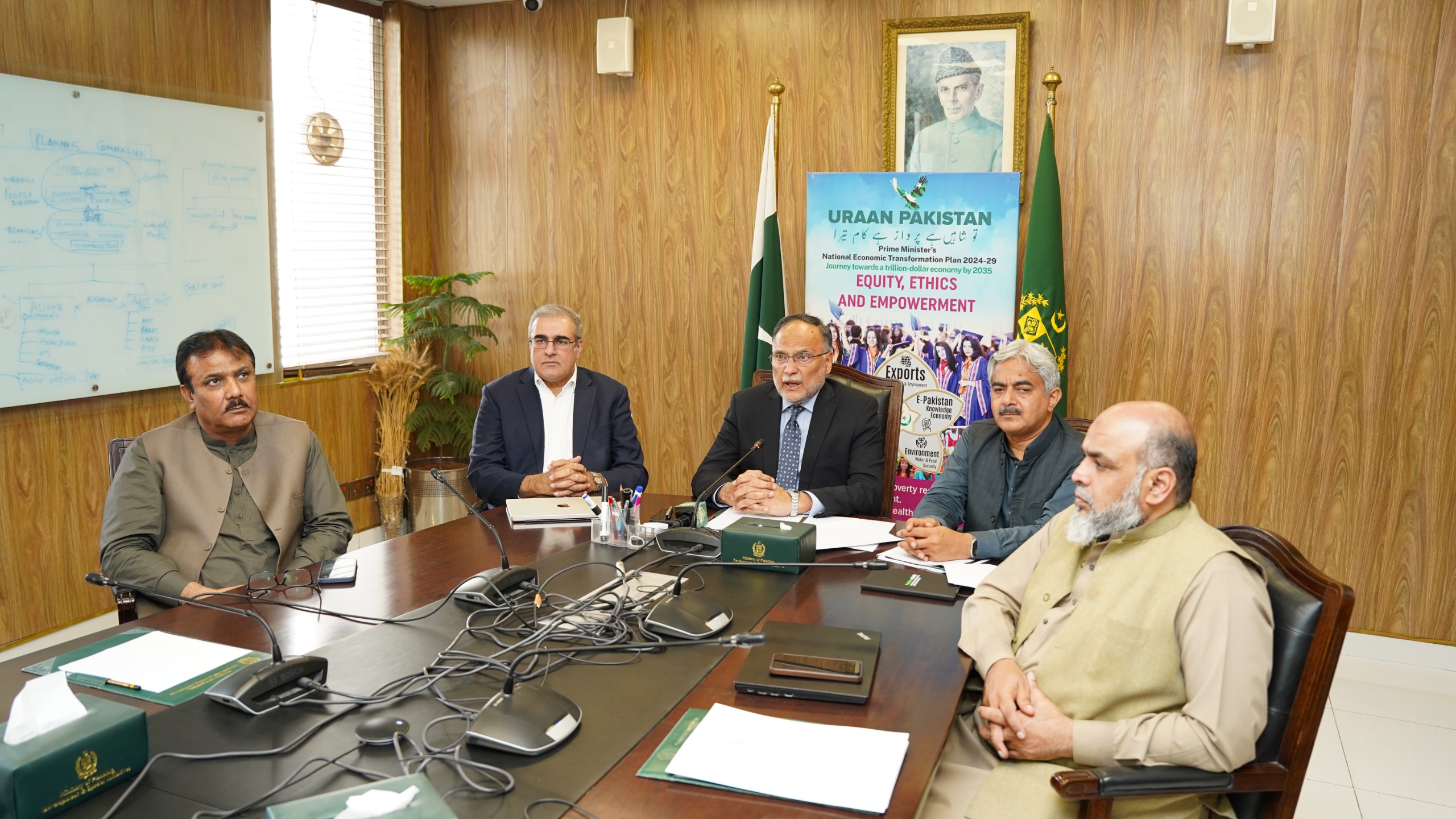
Islamabad, 20th April 2026 :The Federal Minister for Planning, Development & Special Initiatives, Ahsan Iqbal, addressed media representatives virtually at the launch of the Ministry’s Monthly Development Report, highlighting Pakistan’s macroeconomic stability, development progress, and strategic responses to emerging global challenges. The meeting was attended by secretary Planning Awais Manzor Sumra, Chief Economist Dr. Imtiaz Ahmad and senior officials from the Ministry.
The Minister noted that despite challenging global conditions, Pakistan’s economy has demonstrated notable stabilization during the first eight months of the current fiscal year. Inflation has declined to 5.5 percent, while economic activity has improved significantly, with growth rising to 3.8 percent in the first half compared to 1.9 percent last year. He said this improvement reflects better performance in both external and fiscal sectors, supported by ongoing reforms and prudent economic management.
Referring to global developments, Ahsan Iqbal said the conflict in the Middle East has emerged as a major external shock for the world economy, affecting growth and inflationary trends. He stated that the International Monetary Fund has revised global growth projections downward to 3.1 percent for 2026, compared to the pre-war estimate of 3.3 percent, while global headline inflation is expected to rise to 4.4 percent from 3.8 percent. He added that the conflict poses significant risks for Pakistan’s economy through higher global oil prices, increased import bills, inflationary pressures, and vulnerabilities in the external sector including exports and remittances.
The Minister highlighted that Pakistan has also faced domestic inflationary pressures, with average inflation rising to 5.7 percent during July–March FY2026 compared to 5.3 percent last year. Monthly inflation in March 2026 increased sharply to 7.3 percent from 0.7 percent in the same month last year. He explained that this increase is primarily driven by non-food components, especially energy costs linked to global oil price shocks and tariff adjustments, while food inflation has remained relatively contained, requiring continued monitoring and targeted policy interventions.
Ahsan Iqbal emphasized that the government has adopted a balanced and proactive approach to manage energy price volatility. He said the government took difficult decisions, including an increase of Rs. 55 per liter in petrol and diesel prices while absorbing a fiscal burden of Rs. 129 billion to shield citizens from full pass-through of global oil prices. Subsequently, due to the closure of the Strait of Hormuz and sharp increases in global oil prices, petroleum prices were further adjusted upward by Rs. 137 per liter for petrol and Rs. 184.5 per liter for diesel.
He added that as global prices stabilized, the government passed on relief to the public by reducing petroleum prices, including a Rs. 80 per liter reduction in petroleum levy, followed by a price cut of Rs. 12 per liter in petrol and Rs. 135 per liter in diesel on April 11, 2026. In view of the upcoming harvesting season, diesel prices were further reduced by Rs. 32.12 per liter on April 17, 2026, ensuring relief for farmers and the agriculture sector. He said these measures reflect the government’s commitment to protecting citizens from global price volatility while safeguarding purchasing power.
The Minister also highlighted Pakistan’s proactive diplomatic engagement in the Middle East conflict, stating that Pakistan, leveraging its balanced relations with the United States and Iran, has emerged as a credible mediator contributing to de-escalation efforts and regional stability. He noted that successful diplomacy has also helped ease geopolitical tensions, which has had a positive impact on global oil prices.
On development and economic indicators, Ahsan Iqbal stated that large-scale manufacturing recorded a strong recovery of 5.9 percent growth during July–February FY2026, with 15 out of 22 sectors showing positive performance, including automobiles, textiles, food, tobacco, apparel, and non-metallic minerals. He further noted that FBR revenues reached Rs. 9.3 trillion during July–March FY2025, reflecting a 10.1 percent increase, supported by improved enforcement and administrative reforms.
He said remittances remained strong at $30.3 billion, growing by 8.2 percent, while exports of goods and services reached $30.6 billion during July–March FY2026. Services exports grew significantly by 17 percent to $7.3 billion, resulting in a 7 percent reduction in the services deficit. The current account also showed resilience, posting a surplus of $1.07 billion in March 2026, although the cumulative surplus for July–March stood at $8 million compared to $1.67 billion last year.
On fiscal and development performance, the Minister stated that PSDP utilization reached 42 percent (Rs. 415 billion), higher than last year’s 36.4 percent, reflecting increased development activity. CDWP approved seven projects and referred four to ECNEC, which are expected to generate thousands of direct and indirect employment opportunities. He further highlighted that Rs. 10.5 billion were saved through improved cost rationalization, reflecting enhanced efficiency in project planning.
Ahsan Iqbal also underscored major development initiatives including the Jinnah Medical Complex & Research Center, a flagship 1,000-bed healthcare project aimed at strengthening healthcare delivery and reducing medical tourism. He emphasized the government’s focus on human capital development under Pakistan–China AI cooperation, with the Higher Education Commission tasked to align scholarships with emerging fields such as artificial intelligence, robotics, and Industry 4.0 to prepare youth for future economies.
He further highlighted international development cooperation, including engagement with the Islamic Development Bank for financing support under MCPS 2026–30, strengthened climate cooperation with China under CPEC 2.0, formalization of outcomes from the 14th Joint Cooperation Committee, and Pakistan–Türkiye knowledge sharing initiatives in key socio-economic sectors.
Concluding the briefing, the Minister said that despite global uncertainty, Pakistan is moving towards economic stabilization through disciplined reforms, prudent fiscal management, strategic diplomacy, and sustained development efforts aimed at long-term growth and prosperity.
The Minister noted that despite challenging global conditions, Pakistan’s economy has demonstrated notable stabilization during the first eight months of the current fiscal year. Inflation has declined to 5.5 percent, while economic activity has improved significantly, with growth rising to 3.8 percent in the first half compared to 1.9 percent last year. He said this improvement reflects better performance in both external and fiscal sectors, supported by ongoing reforms and prudent economic management.
Referring to global developments, Ahsan Iqbal said the conflict in the Middle East has emerged as a major external shock for the world economy, affecting growth and inflationary trends. He stated that the International Monetary Fund has revised global growth projections downward to 3.1 percent for 2026, compared to the pre-war estimate of 3.3 percent, while global headline inflation is expected to rise to 4.4 percent from 3.8 percent. He added that the conflict poses significant risks for Pakistan’s economy through higher global oil prices, increased import bills, inflationary pressures, and vulnerabilities in the external sector including exports and remittances.
The Minister highlighted that Pakistan has also faced domestic inflationary pressures, with average inflation rising to 5.7 percent during July–March FY2026 compared to 5.3 percent last year. Monthly inflation in March 2026 increased sharply to 7.3 percent from 0.7 percent in the same month last year. He explained that this increase is primarily driven by non-food components, especially energy costs linked to global oil price shocks and tariff adjustments, while food inflation has remained relatively contained, requiring continued monitoring and targeted policy interventions.
Ahsan Iqbal emphasized that the government has adopted a balanced and proactive approach to manage energy price volatility. He said the government took difficult decisions, including an increase of Rs. 55 per liter in petrol and diesel prices while absorbing a fiscal burden of Rs. 129 billion to shield citizens from full pass-through of global oil prices. Subsequently, due to the closure of the Strait of Hormuz and sharp increases in global oil prices, petroleum prices were further adjusted upward by Rs. 137 per liter for petrol and Rs. 184.5 per liter for diesel.
He added that as global prices stabilized, the government passed on relief to the public by reducing petroleum prices, including a Rs. 80 per liter reduction in petroleum levy, followed by a price cut of Rs. 12 per liter in petrol and Rs. 135 per liter in diesel on April 11, 2026. In view of the upcoming harvesting season, diesel prices were further reduced by Rs. 32.12 per liter on April 17, 2026, ensuring relief for farmers and the agriculture sector. He said these measures reflect the government’s commitment to protecting citizens from global price volatility while safeguarding purchasing power.
The Minister also highlighted Pakistan’s proactive diplomatic engagement in the Middle East conflict, stating that Pakistan, leveraging its balanced relations with the United States and Iran, has emerged as a credible mediator contributing to de-escalation efforts and regional stability. He noted that successful diplomacy has also helped ease geopolitical tensions, which has had a positive impact on global oil prices.
On development and economic indicators, Ahsan Iqbal stated that large-scale manufacturing recorded a strong recovery of 5.9 percent growth during July–February FY2026, with 15 out of 22 sectors showing positive performance, including automobiles, textiles, food, tobacco, apparel, and non-metallic minerals. He further noted that FBR revenues reached Rs. 9.3 trillion during July–March FY2025, reflecting a 10.1 percent increase, supported by improved enforcement and administrative reforms.
He said remittances remained strong at $30.3 billion, growing by 8.2 percent, while exports of goods and services reached $30.6 billion during July–March FY2026. Services exports grew significantly by 17 percent to $7.3 billion, resulting in a 7 percent reduction in the services deficit. The current account also showed resilience, posting a surplus of $1.07 billion in March 2026, although the cumulative surplus for July–March stood at $8 million compared to $1.67 billion last year.
On fiscal and development performance, the Minister stated that PSDP utilization reached 42 percent (Rs. 415 billion), higher than last year’s 36.4 percent, reflecting increased development activity. CDWP approved seven projects and referred four to ECNEC, which are expected to generate thousands of direct and indirect employment opportunities. He further highlighted that Rs. 10.5 billion were saved through improved cost rationalization, reflecting enhanced efficiency in project planning.
Ahsan Iqbal also underscored major development initiatives including the Jinnah Medical Complex & Research Center, a flagship 1,000-bed healthcare project aimed at strengthening healthcare delivery and reducing medical tourism. He emphasized the government’s focus on human capital development under Pakistan–China AI cooperation, with the Higher Education Commission tasked to align scholarships with emerging fields such as artificial intelligence, robotics, and Industry 4.0 to prepare youth for future economies.
He further highlighted international development cooperation, including engagement with the Islamic Development Bank for financing support under MCPS 2026–30, strengthened climate cooperation with China under CPEC 2.0, formalization of outcomes from the 14th Joint Cooperation Committee, and Pakistan–Türkiye knowledge sharing initiatives in key socio-economic sectors.
Concluding the briefing, the Minister said that despite global uncertainty, Pakistan is moving towards economic stabilization through disciplined reforms, prudent fiscal management, strategic diplomacy, and sustained development efforts aimed at long-term growth and prosperity.