
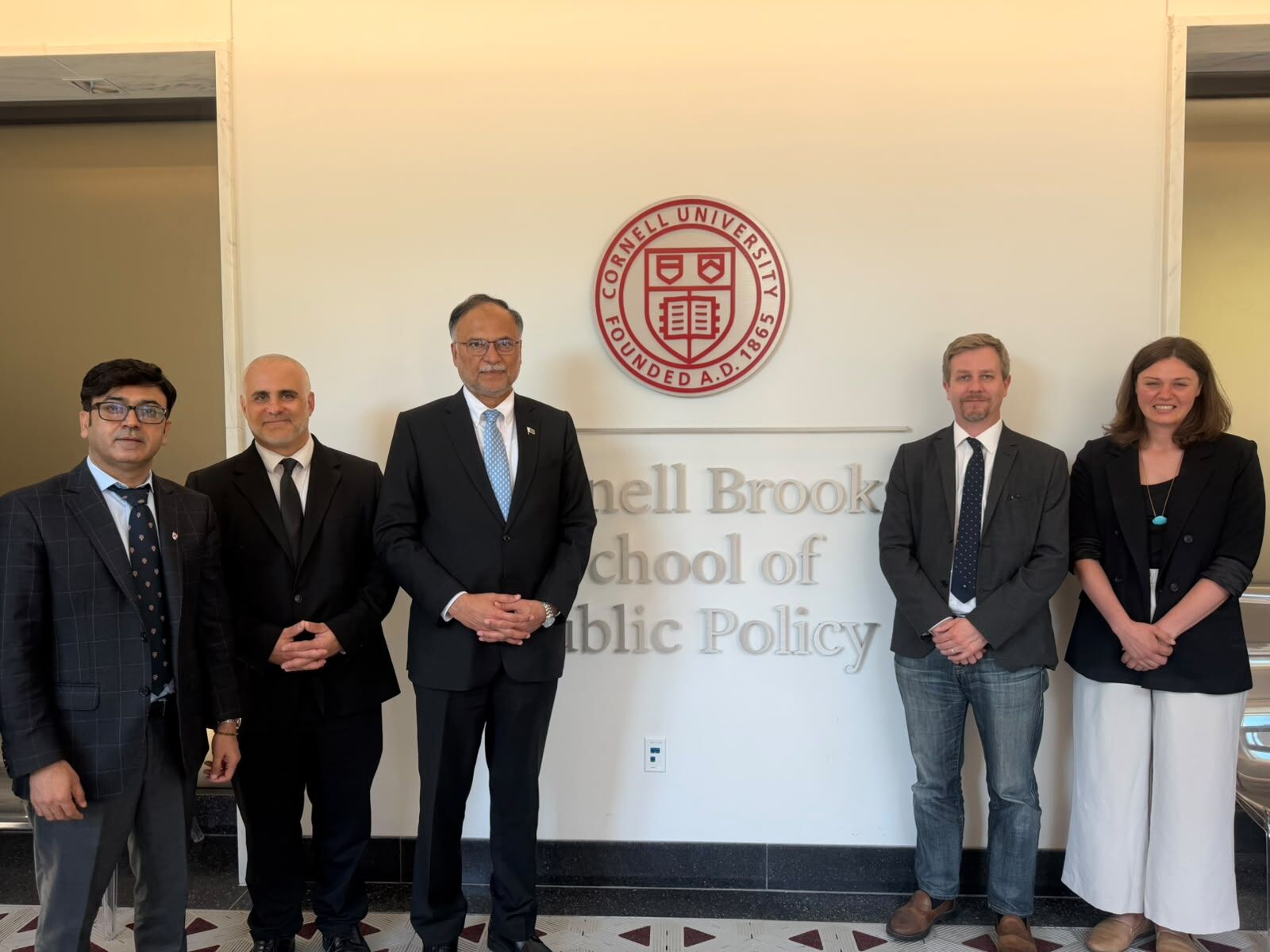
New York | July 15, 2026: Federal Minister for Planning, Development & Special Initiatives, Ahsan Iqbal, visited Cornell University on Wednesday during the United States visit, where he held a series of high-level meetings with the University's academic leadership, researchers and faculty to strengthen collaboration in higher education, scientific research, innovation, agriculture, biotechnology, artificial intelligence and public policy.
During his meeting with Cornell University Provost, Prof. Dr. Kavita Bala, and the Vice Provost for International Affairs, the Minister underscored that investment in universities is the foundation of national progress, noting that America's global leadership has been built on the strength of its world-class universities that generate ideas, knowledge and innovation which ultimately shape society, the economy, governance and national security.
Highlighting Pakistan's commitment to developing a knowledge-based economy, the Minister briefed Cornell leadership on the Government's flagship US–Pakistan Knowledge Corridor initiative , launched to enable 1 0,000 Pakistani scholars to pursue PhD studies at leading international universities. He emphasized that Pakistan seeks to strengthen its human capital in critical fields including artificial intelligence, climate science, agricultural technology and biotechnology to improve national productivity, competitiveness and innovation.
The Minister proposed three major areas of institutional collaboration between Pakistan and Cornell University. First, he invited Cornell's Brooks School of Public Policy to partner with Pakistan's National School of Public Policy (NSPP) in supporting its transformation into a National University of Public Administration through faculty collaboration, curriculum development and executive training. He noted that while overseas training opportunities remain valuable, building institutional capacity within Pakistan is essential for preparing the country's future civil service.
Secondly, the Minister invited Cornell University to partner with Pakistan's upcoming Dr. Ishfaq Ahmad Center of Excellence on Emerging Technologies, which will focus on frontier research in biotechnology, agricultural technology, artificial intelligence and other strategic technologies. He said Cornell's internationally recognized expertise would make it an ideal partner in building a vibrant ecosystem connecting research, entrepreneurship, academia and industry.
The Minister also proposed collaboration on studying the impact of artificial intelligence on higher education, expressing Pakistan's interest in learning from Cornell's research on the future of universities and AI-enabled teaching and learning.
Cornell leadership welcomed the proposals and expressed keen interest in expanding academic engagement with Pakistan. The University also conveyed its willingness to encourage greater participation of Pakistani students in graduate and doctoral programmes, including through Fulbright-supported opportunities.
During his visit to the C ornell Institute of Biotechnology and the Cornell College of Agriculture and Life Sciences (CALS), the Minister met Executive Director Dr. Tami Magnus, Dean Prof. Dr. Lori Leonard and Professor Dr. Awais Khan, where discussions focused on agricultural research, biotechnology, digital agriculture, innovation and climate resilience.
Describing Pakistan as an agrarian economy, the Minister stressed that enhancing agricultural productivity, quality and value addition is critical for achieving sustainable economic growth and food security. He said Pakistan is pursuing climate-resilient agriculture under the Government's URAAN Pakistan initiative and called for stronger collaboration with Cornell in plant sciences, biotechnology, precision agriculture and digital extension services.
The Minister proposed establishing joint applied research initiatives, including the development of a centralized research laboratory, collaboration on improved crop varieties and rootstocks, cluster mapping of Pakistan's agricultural potential and strengthening the entire agricultural value chain—from breeding, irrigation and mechanization to commercialization and export competitiveness.
The Minister also visited the Center for Life Science Ventures (CLSV) , where he received a comprehensive briefing from Dr. Ying Yang on Cornell's innovation ecosystem a nd toured biotechnology startup companies operating within the University's innovation center.
In a separate meeting held with Dr. Lou Walcher, Founding Director of CLSV , discussions focused on strengthening Pakistan's innovation ecosystem through technology commercialization, startup incubation and university-industry partnerships. The Minister highlighted the Government's objective of transforming university research into market-oriented applied research that addresses national development challenges while supporting private sector growth.
He invited Cornell experts to assist Pakistan in establishing innovation centers capable of nurturing technology startups and entrepreneurial ventures and requested the sharing of institutional frameworks and best practices that have successfully supported innovation ecosystems in other developing countries.
During his visit to Cornell's Brooks School of Public Policy , the Minister also participated in discussions on expanding academic and policy collaboration aimed at promoting cooperation in public policy education, research and capacity building between Cornell University and Pakistan's Ministry of Planning, Development & Special Initiatives and the Planning Commission.
Addressing a roundtable with Pakistani researchers and students at Cornell University, the Minister highlighted the Government's ongoing higher education reforms and emphasized the importance of research excellence, innovation, entrepreneurship and international academic collaboration in preparing Pakistan's youth for emerging global opportunities. He encouraged Pakistani scholars abroad to contribute their knowledge, expertise and research networks towards Pakistan's national development.
The Minister concluded his engagements by interacting with members of the Pakistani American community, faculty members and researchers during a community dinner, where he appreciated the important role of the Pakistani diaspora in strengthening educational, scientific and economic partnerships between Pakistan and the United States.
During his meeting with Cornell University Provost, Prof. Dr. Kavita Bala, and the Vice Provost for International Affairs, the Minister underscored that investment in universities is the foundation of national progress, noting that America's global leadership has been built on the strength of its world-class universities that generate ideas, knowledge and innovation which ultimately shape society, the economy, governance and national security.
Highlighting Pakistan's commitment to developing a knowledge-based economy, the Minister briefed Cornell leadership on the Government's flagship US–Pakistan Knowledge Corridor initiative , launched to enable 1 0,000 Pakistani scholars to pursue PhD studies at leading international universities. He emphasized that Pakistan seeks to strengthen its human capital in critical fields including artificial intelligence, climate science, agricultural technology and biotechnology to improve national productivity, competitiveness and innovation.
The Minister proposed three major areas of institutional collaboration between Pakistan and Cornell University. First, he invited Cornell's Brooks School of Public Policy to partner with Pakistan's National School of Public Policy (NSPP) in supporting its transformation into a National University of Public Administration through faculty collaboration, curriculum development and executive training. He noted that while overseas training opportunities remain valuable, building institutional capacity within Pakistan is essential for preparing the country's future civil service.
Secondly, the Minister invited Cornell University to partner with Pakistan's upcoming Dr. Ishfaq Ahmad Center of Excellence on Emerging Technologies, which will focus on frontier research in biotechnology, agricultural technology, artificial intelligence and other strategic technologies. He said Cornell's internationally recognized expertise would make it an ideal partner in building a vibrant ecosystem connecting research, entrepreneurship, academia and industry.
The Minister also proposed collaboration on studying the impact of artificial intelligence on higher education, expressing Pakistan's interest in learning from Cornell's research on the future of universities and AI-enabled teaching and learning.
Cornell leadership welcomed the proposals and expressed keen interest in expanding academic engagement with Pakistan. The University also conveyed its willingness to encourage greater participation of Pakistani students in graduate and doctoral programmes, including through Fulbright-supported opportunities.
During his visit to the C ornell Institute of Biotechnology and the Cornell College of Agriculture and Life Sciences (CALS), the Minister met Executive Director Dr. Tami Magnus, Dean Prof. Dr. Lori Leonard and Professor Dr. Awais Khan, where discussions focused on agricultural research, biotechnology, digital agriculture, innovation and climate resilience.
Describing Pakistan as an agrarian economy, the Minister stressed that enhancing agricultural productivity, quality and value addition is critical for achieving sustainable economic growth and food security. He said Pakistan is pursuing climate-resilient agriculture under the Government's URAAN Pakistan initiative and called for stronger collaboration with Cornell in plant sciences, biotechnology, precision agriculture and digital extension services.
The Minister proposed establishing joint applied research initiatives, including the development of a centralized research laboratory, collaboration on improved crop varieties and rootstocks, cluster mapping of Pakistan's agricultural potential and strengthening the entire agricultural value chain—from breeding, irrigation and mechanization to commercialization and export competitiveness.
The Minister also visited the Center for Life Science Ventures (CLSV) , where he received a comprehensive briefing from Dr. Ying Yang on Cornell's innovation ecosystem a nd toured biotechnology startup companies operating within the University's innovation center.
In a separate meeting held with Dr. Lou Walcher, Founding Director of CLSV , discussions focused on strengthening Pakistan's innovation ecosystem through technology commercialization, startup incubation and university-industry partnerships. The Minister highlighted the Government's objective of transforming university research into market-oriented applied research that addresses national development challenges while supporting private sector growth.
He invited Cornell experts to assist Pakistan in establishing innovation centers capable of nurturing technology startups and entrepreneurial ventures and requested the sharing of institutional frameworks and best practices that have successfully supported innovation ecosystems in other developing countries.
During his visit to Cornell's Brooks School of Public Policy , the Minister also participated in discussions on expanding academic and policy collaboration aimed at promoting cooperation in public policy education, research and capacity building between Cornell University and Pakistan's Ministry of Planning, Development & Special Initiatives and the Planning Commission.
Addressing a roundtable with Pakistani researchers and students at Cornell University, the Minister highlighted the Government's ongoing higher education reforms and emphasized the importance of research excellence, innovation, entrepreneurship and international academic collaboration in preparing Pakistan's youth for emerging global opportunities. He encouraged Pakistani scholars abroad to contribute their knowledge, expertise and research networks towards Pakistan's national development.
The Minister concluded his engagements by interacting with members of the Pakistani American community, faculty members and researchers during a community dinner, where he appreciated the important role of the Pakistani diaspora in strengthening educational, scientific and economic partnerships between Pakistan and the United States.