
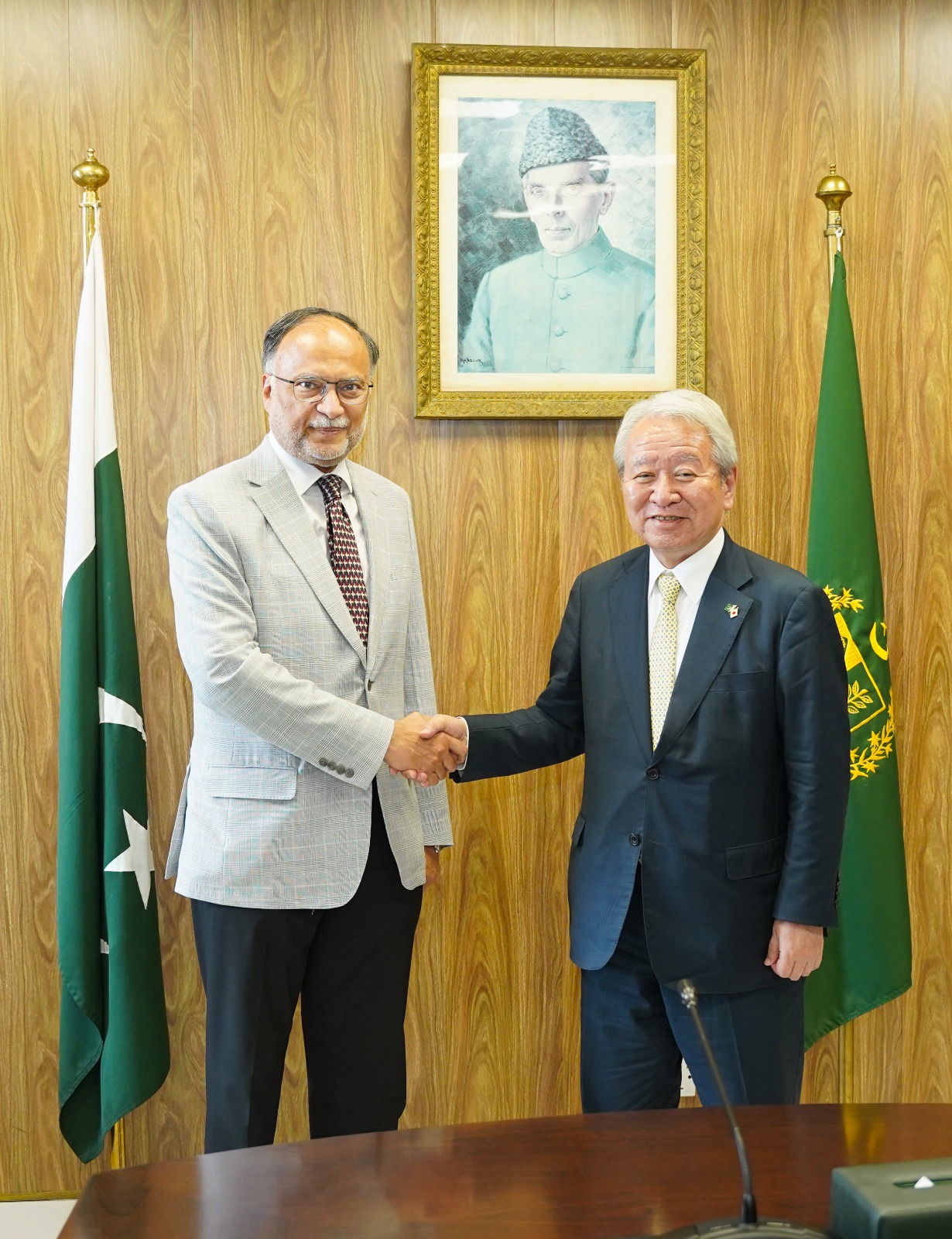
Islamabad, August 05, 2026: President of the Japan International Cooperation Agency (JICA), Dr. Tanaka Akihiko, called on Federal Minister for Planning, Development & Special Initiatives, Prof. Ahsan Iqbal, at the Ministry of Planning today. The meeting focused on strengthening Pakistan-Japan development cooperation and exploring new avenues of collaboration in infrastructure, human resource development, digital transformation, tourism, and sustainable economic growth.
Welcoming the JICA President, Federal Minister Ahsan Iqbal expressed appreciation for Japan's longstanding Official Development Assistance (ODA) to Pakistan and commended JICA's continued support in the fields of infrastructure, energy, water resources, health, education, agriculture, and disaster risk management. He acknowledged Japan as one of Pakistan's most trusted development partners, whose cooperation has made significant contributions to the country's socio-economic development over the decades.
The Minister briefed the delegation on Pakistan's improving economic outlook, highlighting the government's successful efforts to restore macroeconomic stability through prudent economic management and structural reforms under the IMF-supported programme. He stated that Pakistan had overcome difficult economic challenges through collective national efforts and was now firmly on the path toward sustainable economic growth.
Ahsan Iqbal informed the delegation that the government's reform agenda had led to a substantial improvement in public finances, with government revenues doubling over the past three years. He reaffirmed the government's commitment to maintaining fiscal discipline, ensuring macroeconomic stability, and pursuing investment-led, sustainable economic growth.
Highlighting the government's long-term development vision, the Minister briefed the delegation on the URAAN Pakistan initiative and its 5Es Framework, which serves as the country's medium and long-term roadmap for national transformation. He explained that the framework focuses on Exports, E-Pakistan, Environment & Climate Change, Energy & Infrastructure, and Equity & Empowerment as the five strategic pillars for achieving sustainable and inclusive development.
The Minister emphasized that export-led growth remains the cornerstone of Pakistan's long-term economic strategy. He observed that Pakistan's economy had historically faced structural challenges due to low export growth and excessive reliance on imports. He stressed that no country can achieve lasting economic prosperity without building a strong export base, adding that sustainable economic growth must be anchored in expanding exports rather than consumption-driven growth. In this regard, he noted that the government is actively investing in modern infrastructure and regional connectivity to enhance Pakistan's export competitiveness and provide a solid foundation for long-term economic resilience.
Referring to Pakistan's demographic profile, the Minister noted that nearly 60 percent of the country's population comprises young people, describing this as Pakistan's greatest national asset. He emphasized that equipping youth with quality education, technical skills, modern vocational training, and dignified employment opportunities remains among the government's highest priorities. He further underlined that women's economic empowerment is equally essential for achieving inclusive and sustainable national development.
Discussing avenues for enhanced bilateral cooperation, Federal Minister Ahsan Iqbal proposed the development of a Pakistan-Japan Gandhara Tourism Corridor , highlighting the centuries-old cultural and civilizational ties between the two countries. He said the shared Gandhara heritage offers significant potential to promote cultural exchanges, religious tourism, and people-to-people contacts.
Highlighting Pakistan's recent accession to the Productivity, Quality and Innovation (PQI) initiative, Federal Minister Ahsan Iqbal said the initiative will help enhance Pakistan's industrial competitiveness and support export-led growth. He expressed the hope that JICA would extend its technical cooperation to support Pakistan in successfully implementing and expanding the Productivity, Quality and Innovation (PQI) initiative in collaboration with the Japan Productivity Center (JPC). He also proposed the establishment of a joint working group to identify and develop tangible collaborative projects.
Speaking on the occasion, JICA President Dr. Tanaka Akihiko reaffirmed Japan's commitment to further strengthening its long-standing development partnership with Pakistan. Appreciating Pakistan's economic reforms and improving macroeconomic stability, he said these provide a strong foundation for expanding future cooperation. He emphasized the need for close coordination between JICA and the Ministry of Planning to develop high-impact projects aligned with URAAN Pakistan, particularly in human resource development, infrastructure, disaster risk management, education, SMEs, digital transformation, tourism, special economic zones, productivity enhancement, and the Productivity, Quality and Innovation (PQI) initiative. He agreed to establishing a dedicated coordination mechanism, including technical workshops and regular consultations with JICA's Tokyo headquarters, to identify new areas of collaboration aligned with 5Es framework and accelerate project implementation. Dr. Tanaka also expressed JICA's desire to revive the momentum of bilateral cooperation and reaffirmed Japan's commitment to supporting Pakistan's sustainable and inclusive economic development.
Welcoming the JICA President, Federal Minister Ahsan Iqbal expressed appreciation for Japan's longstanding Official Development Assistance (ODA) to Pakistan and commended JICA's continued support in the fields of infrastructure, energy, water resources, health, education, agriculture, and disaster risk management. He acknowledged Japan as one of Pakistan's most trusted development partners, whose cooperation has made significant contributions to the country's socio-economic development over the decades.
The Minister briefed the delegation on Pakistan's improving economic outlook, highlighting the government's successful efforts to restore macroeconomic stability through prudent economic management and structural reforms under the IMF-supported programme. He stated that Pakistan had overcome difficult economic challenges through collective national efforts and was now firmly on the path toward sustainable economic growth.
Ahsan Iqbal informed the delegation that the government's reform agenda had led to a substantial improvement in public finances, with government revenues doubling over the past three years. He reaffirmed the government's commitment to maintaining fiscal discipline, ensuring macroeconomic stability, and pursuing investment-led, sustainable economic growth.
Highlighting the government's long-term development vision, the Minister briefed the delegation on the URAAN Pakistan initiative and its 5Es Framework, which serves as the country's medium and long-term roadmap for national transformation. He explained that the framework focuses on Exports, E-Pakistan, Environment & Climate Change, Energy & Infrastructure, and Equity & Empowerment as the five strategic pillars for achieving sustainable and inclusive development.
The Minister emphasized that export-led growth remains the cornerstone of Pakistan's long-term economic strategy. He observed that Pakistan's economy had historically faced structural challenges due to low export growth and excessive reliance on imports. He stressed that no country can achieve lasting economic prosperity without building a strong export base, adding that sustainable economic growth must be anchored in expanding exports rather than consumption-driven growth. In this regard, he noted that the government is actively investing in modern infrastructure and regional connectivity to enhance Pakistan's export competitiveness and provide a solid foundation for long-term economic resilience.
Referring to Pakistan's demographic profile, the Minister noted that nearly 60 percent of the country's population comprises young people, describing this as Pakistan's greatest national asset. He emphasized that equipping youth with quality education, technical skills, modern vocational training, and dignified employment opportunities remains among the government's highest priorities. He further underlined that women's economic empowerment is equally essential for achieving inclusive and sustainable national development.
Discussing avenues for enhanced bilateral cooperation, Federal Minister Ahsan Iqbal proposed the development of a Pakistan-Japan Gandhara Tourism Corridor , highlighting the centuries-old cultural and civilizational ties between the two countries. He said the shared Gandhara heritage offers significant potential to promote cultural exchanges, religious tourism, and people-to-people contacts.
Highlighting Pakistan's recent accession to the Productivity, Quality and Innovation (PQI) initiative, Federal Minister Ahsan Iqbal said the initiative will help enhance Pakistan's industrial competitiveness and support export-led growth. He expressed the hope that JICA would extend its technical cooperation to support Pakistan in successfully implementing and expanding the Productivity, Quality and Innovation (PQI) initiative in collaboration with the Japan Productivity Center (JPC). He also proposed the establishment of a joint working group to identify and develop tangible collaborative projects.
Speaking on the occasion, JICA President Dr. Tanaka Akihiko reaffirmed Japan's commitment to further strengthening its long-standing development partnership with Pakistan. Appreciating Pakistan's economic reforms and improving macroeconomic stability, he said these provide a strong foundation for expanding future cooperation. He emphasized the need for close coordination between JICA and the Ministry of Planning to develop high-impact projects aligned with URAAN Pakistan, particularly in human resource development, infrastructure, disaster risk management, education, SMEs, digital transformation, tourism, special economic zones, productivity enhancement, and the Productivity, Quality and Innovation (PQI) initiative. He agreed to establishing a dedicated coordination mechanism, including technical workshops and regular consultations with JICA's Tokyo headquarters, to identify new areas of collaboration aligned with 5Es framework and accelerate project implementation. Dr. Tanaka also expressed JICA's desire to revive the momentum of bilateral cooperation and reaffirmed Japan's commitment to supporting Pakistan's sustainable and inclusive economic development.