
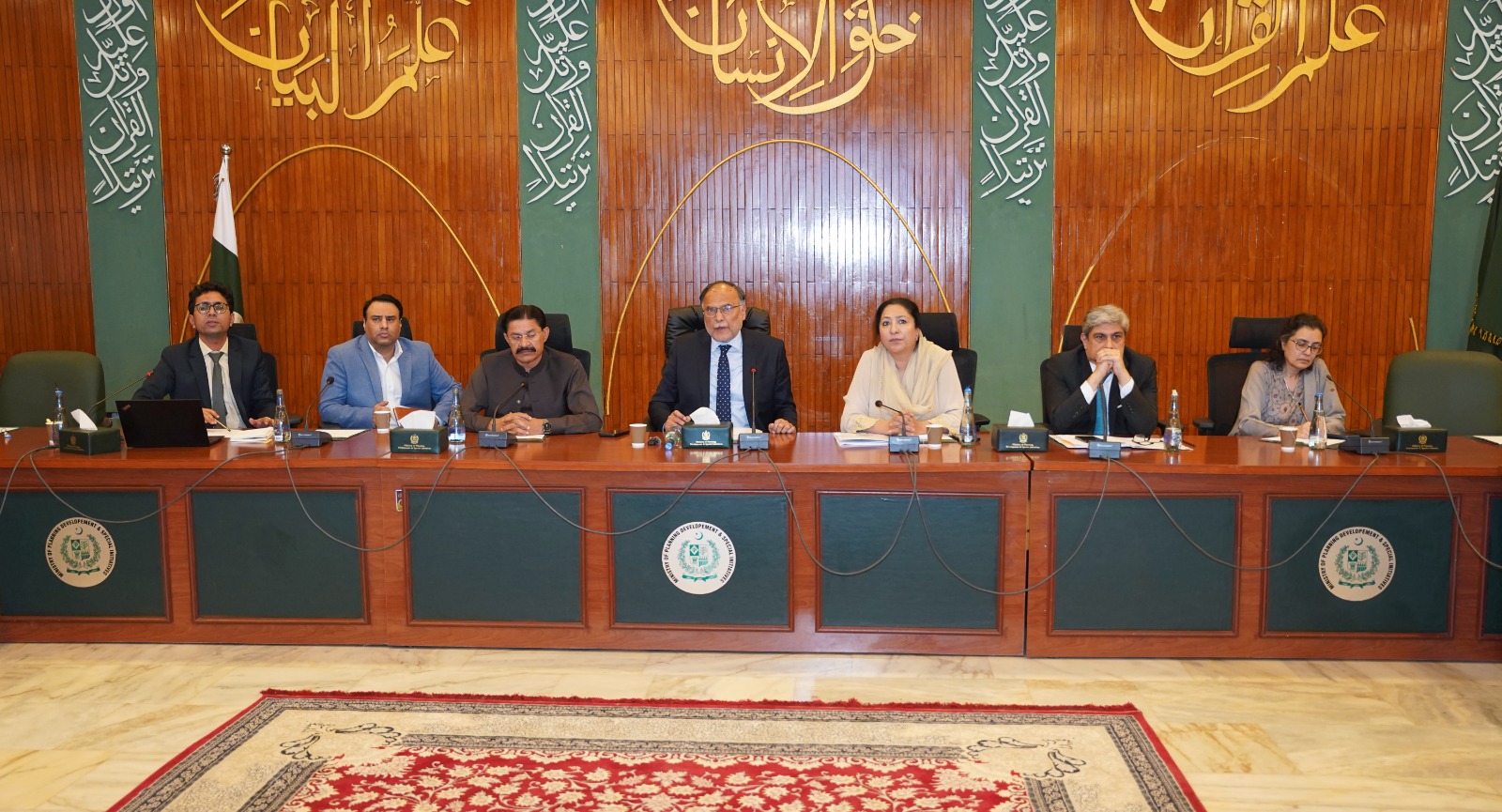
Islamabad, 6th Nov 2026 : Federal Minister for Planning, Development and Special Initiatives Ahsan Iqbal, while chairing a meeting of the Joint Committee on ICT Education Reforms directed that comprehensive proposals for restructuring of the education sector be developed to make education sector a model of reform.
The meeting was attended by MNA Raja Khurram Nawaz, Parliamentary Secretary for Education Wajiha Qamar, Secretary Education, Members of Social Sector and Governance from Planning Commission, and representatives of relevant departments and senior education experts from private sector
The Minister said the Prime Minister had directed the preparation of an accelerated and actionable reform plan for Islamabad's education system and endorse the concept of an autonomous education authority for ICT. He emphasized that the proposed authority should have an independent-majority BoG and a merit-selected Chief Executive Officer, with clearly defined functions, powers and terms of reference. He directed the relevant authorities to prepare the required legislation and a transition roadmap within 60 days, ensuring that the FDE continues its operations without interruption during the transition.
This was part of a high level meeting of the committee which deliberated on direction of the PM to bring governance and quality reforms in ICT education.
Ahsan Iqbal stressed that the proposed authority should enjoy greater administrative and operational autonomy, with a clear ICT-wide mandate covering all education providers. He said effective monitoring must be directly linked with corrective action and accountability, observing that despite substantial government investment and higher employee-related expenditure, public-sector schools were not delivering results commensurate with available resources. He noted that approximately 77 percent of the FDE's expenditure ceiling was employee-related, highlighting the need to improve institutional performance and ensure value for public money.
Referring to the proposed recruitment of 1,100 teachers through FPSC, the Minister called for reviewing the recruitment process and exploring a contractual hiring model to attract highly qualified and talented young professionals, drawing lessons from Punjab's earlier initiative of recruiting educated teachers on a five-year contract. He also directed the relevant authorities to examine the legal aspects of the proposed appointments and ensure that recruitment terms provide for local hiring and school-based placements, preventing unnecessary transfers and ensuring teachers remain connected with the communities they serve.
Highlighting the importance of teaching quality, the Minister observed that Pakistan needed to learn from international education models, particularly China's emphasis on strong teacher-student engagement. He stressed that reforms must prioritize equity and student welfare, alongside improvements in teaching standards, curriculum and learning outcomes.
On school infrastructure, Ahsan Iqbal directed that safe and functional school structure and facility must be the first priority, followed by a costed and verified improvement plan to bring every institution up to model standards, with priority given to rural schools. He emphasized that infrastructure planning must also address the specific needs of girls' education.
MNA Raja Khurram Nawaz highlighted the shortage of facilities in government schools, particularly the need for additional blocks for girls. He also stressed the importance of a uniform curriculum across public and private schools to reduce educational disparities and the growing social divide among students.
While giving the presentation by Planning Commission they briefed the committee that the FDE network currently comprises 432 educational institutions, while a much larger number of private schools (including low fee PVT schools) as well as informal schools and special education schools, operate in Islamabad. Ensuring quality facilities in these as a government responsibility. In pursuance of Pm directions and first meeting of the joint committee 3 working groups were constituted to focus on infrastructure, governance and academics. The proposed reform architecture is structured around eight key themes: Governance and Institutional Architecture; Safe Schools, Standards and Infrastructure; Financing and School-Level Autonomy; Teachers and School Leadership; Curriculum, Pedagogy and Foundational Learning; Assessment, Data and Accountability; and Access, Equity and Student Welfare, supported by an implementation and sequencing framework.
The Minister called for coordinated efforts by all relevant stakeholders to translate the proposed reforms into a practical, time-bound framework focused on improving the quality, accessibility and accountability of education in Islamabad.